
Support guide
Teach suggestions while staying in control.
Escape The Paper uses category tags and your previous assignments to propose matches locally. A few deliberate corrections are more useful than a long list of vague tags.
Start with distinctive tags
Add words that reliably appear in transaction descriptions for a category: a merchant name or recognisable description fragment is usually more useful than a broad word. Avoid the same ambiguous tag across unrelated categories.
Open Categories, select a category, and choose Edit Category. Its Tags panel lists the phrases already training that category. Black means Suggest More, red means Suggest Less, and green means Always Assign—the result of enabling Automatically tag.
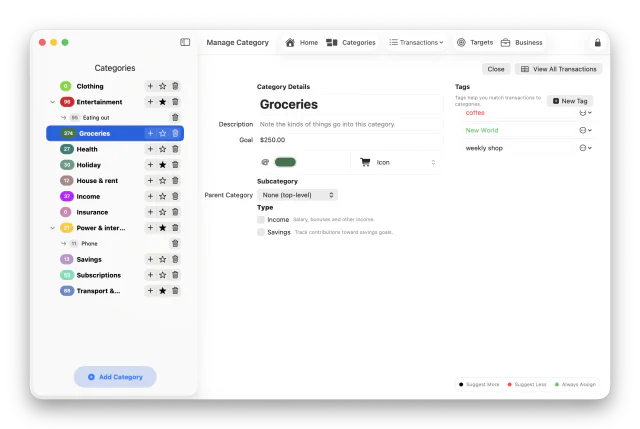
After changing tags, return to Home and press Rebuild suggestions. This refreshes matches using the updated tags and assignment history.
Choose the right feedback action
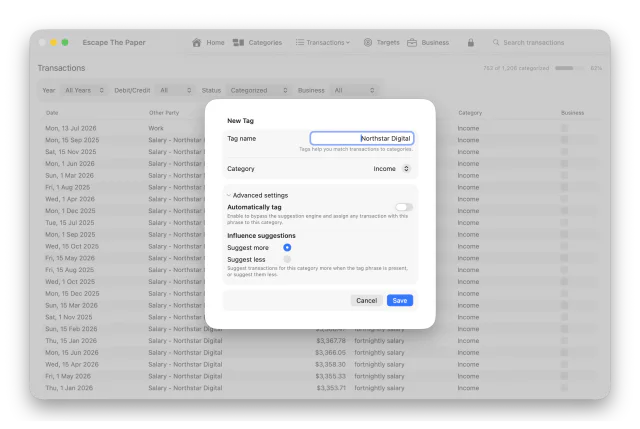
- Suggest More makes that kind of match more likely in future, but still leaves it for review.
- Suggest Less reduces the score of an ambiguous keyword without removing the category itself.
- Automatically tag is the always-assign option: it categorises a clear recurring match without waiting for review.
Prefer Suggest More until the description is reliably unique. Reserve automatic tagging for a rule you would be comfortable accepting without seeing each transaction first.
A practical training loop
- Review uncategorised transactions after an import.
- Correct weak or wrong matches.
- Add a distinctive tag only when the description provides one.
- Use Suggest More or Suggest Less to refine borderline cases.
- Rebuild suggestions from Home after tag edits.
- Check the remaining suggestions before assigning them.
When suggestions are too broad
- Remove generic tags that appear in many unrelated descriptions.
- Use Suggest Less on the ambiguous match.
- Replace a broad tag with a more distinctive merchant fragment.
- Rebuild suggestions and check whether the uncategorised list improves.
Your correction is still the final answer
Suggestions reduce repetitive work; they do not change the meaning of a transaction. Review anything uncertain, especially a description shared by several merchants or a merchant whose purchases span several categories.